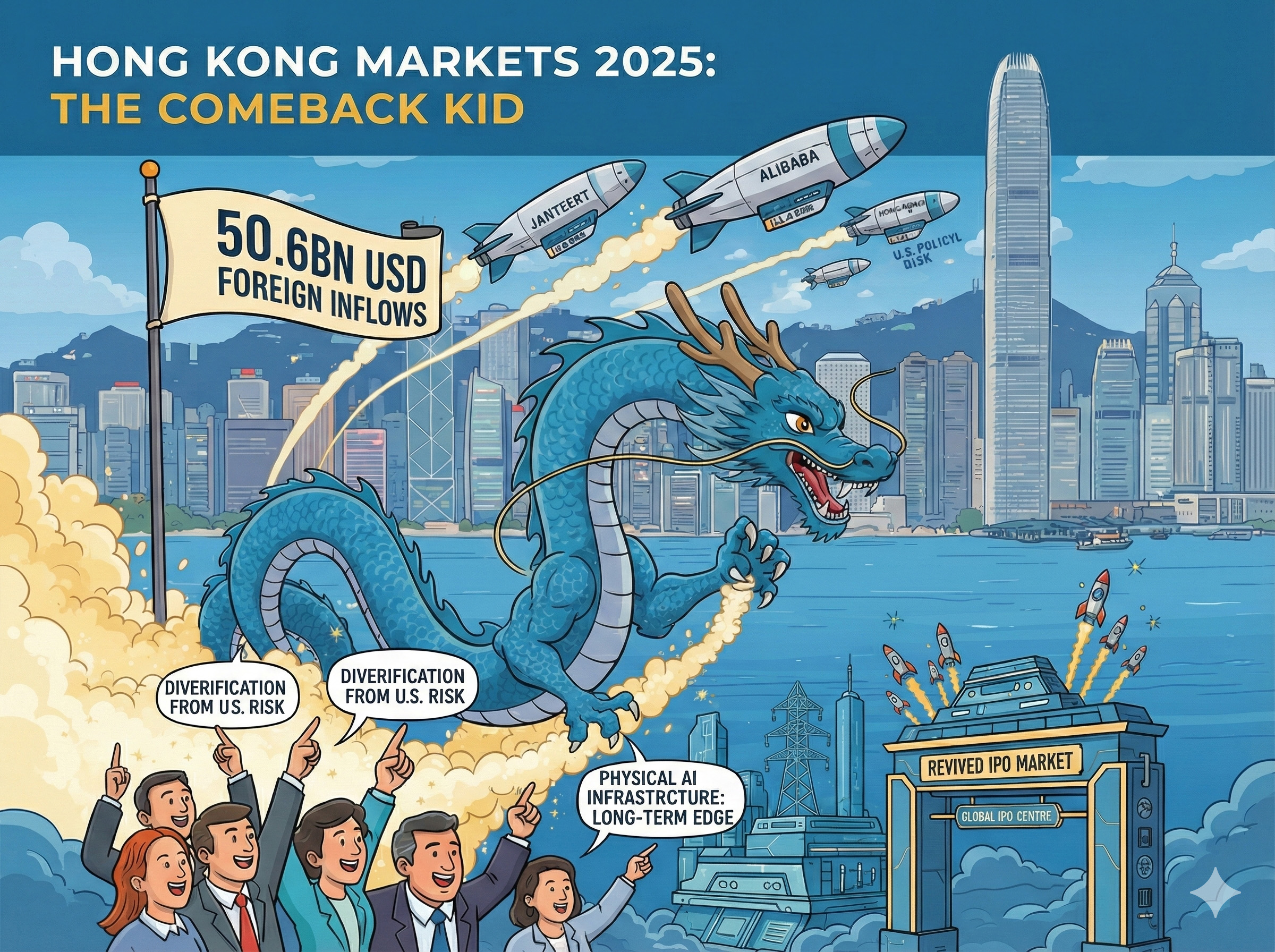

The Hong Kong stock market experienced a notable bull run in 2025, with its year-to-date returns surpassing major Western market benchmarks. The Hang Seng Index delivered about 26% YTD return in 2025, versus about 14% for DJI and 20% for NASDAQ. Leading blue-chip technology companies, including Tencent, Baidu, and Alibaba, have not only recovered but have also outperformed several major US technology counterparts such as Nvidia, Microsoft, and Meta. This upward momentum extends beyond a few internet stocks, reflecting a broad rally.


A red-hot IPO market
The primary market has staged a robust comeback, featuring large listings from groups such as CATL alongside a new wave of technology issuers in autonomous driving and AI. The scale and volume of deals have pushed Hong Kong back into the top tier of global IPO markets. In 2025, Hong Kong’s IPO volume tripled to about USD34bn and is approaching the peak levels between 2018 and 2021. Globally, Hong Kong ranked second and is only about 13% behind the US in terms of funds raised.


Return of international institutional capital
The sustained performance is supported by a shift in confidence among global institutional investors.
- A clear sign of renewed confidence: According to IIF, foreign inflows into China equities surged to USD50.6bn in 10M25, more than three times the full‑year 2024 figure, underscoring a meaningful reallocation into the region. At the same time, international trading firms and asset managers Jane Street and Point72 have expanded their Hong Kong footprints, suggesting a redeployment of people and capital. Jane Street’s new office could more than double its local headcount to over 1,000.
- Market credibility: Jane Street and Millennium have taken cornerstone positions in recent Hong Kong IPOs, the first time in decades, providing capital and lending market credibility.
These movements indicate that global investors will return when the backdrop is favourable.
Why Hong Kong, and why now?
Diversification against US uncertainty
Concerns surrounding potential volatility in the US environment are prompting investors to seek alternatives.
- Political and macro volatility under the current U.S. administration—including tariff risks, surprise policy moves and large fiscal packages (‘The Big Beautiful Bill’—has prompted some investors to rebalance away from the U.S.
- Result: Hong Kong and China equities have emerged as attractive alternatives for investors seeking geographic and policy diversification.
Stabilization in Sino-US relations
A perceived reduction in geopolitical friction enhances the investment outlook for regional assets.
- The relationship between China and the US appears to be shifting towards a more pragmatic path with an emphasis on “making a deal”.
- High-level talks, trade dialogues, and the easing of restrictions regarding specific technologies, such as Nvidia’s H200 chips, collectively indicate a shared desire to reduce rivalry and maintain commercial relationships.
- Result: This reduction in geopolitical risk improves the investment case for both Hong Kong and mainland assets.
China’s improving AI story
Besides geopolitical issues, China’s improving AI story has also attracted international investors back to the market.
What has changed? The market’s view of AI is shifting from GPU toward physical infrastructure constraints—power and construction capacity. In many cases, the new bottleneck is “finding reliable, large‑scale power” rather than just securing GPUs. This elevates physical assets (generation, grid, storage, cooling, and construction) as strategic enablers of AI deployment.
China’s AI Progression
- Despite limits on access to the most advanced GPUs, domestic models such as Qwen and DeepSeek are emerging as lower‑cost, locally optimised alternatives and are beginning to gain international traction.
- Meanwhile, incremental performance gains from recent U.S. models are tapering as much of the easiest high‑quality training data such as web archives and books has already been consumed.
Infrastructure capacity as a long‑term advantage
- U.S. bottlenecks: Hyperscale data centres face rising power, labour and materials constraints that can delay buildouts and increase costs—a risk evident in reported project delays at some providers.
- China’s edge: Coordinated, large‑scale investment in power structures including clean sources, grid upgrades and large energy‑storage projects gives China a structural advantage in supporting sustained, large‑scale AI deployment.
What’s next?
Looking forward, the key question is whether 2025’s strong performance will extend into 2026—stay tuned for Part 2 of the series.
This article is for information only and is not investment advice or a solicitation to buy or sell securities. This article does not constitute a “Personal Recommendation” or investment advice under UK FCA regulations. The author holds NO position in the securities mentioned. There is no warranty as to completeness or correctness. Please do your own due diligence or consult a licensed financial adviser. Investing in Asian markets involves significant risk. Please read the Full Disclaimer before acting on any information. Images and videos created with the assistance of Gemini AI.
Latest posts
Leave a Reply