Analysis for informational purposes only. Capital at risk.
A hidden transformation is taking place behind the living room screen.
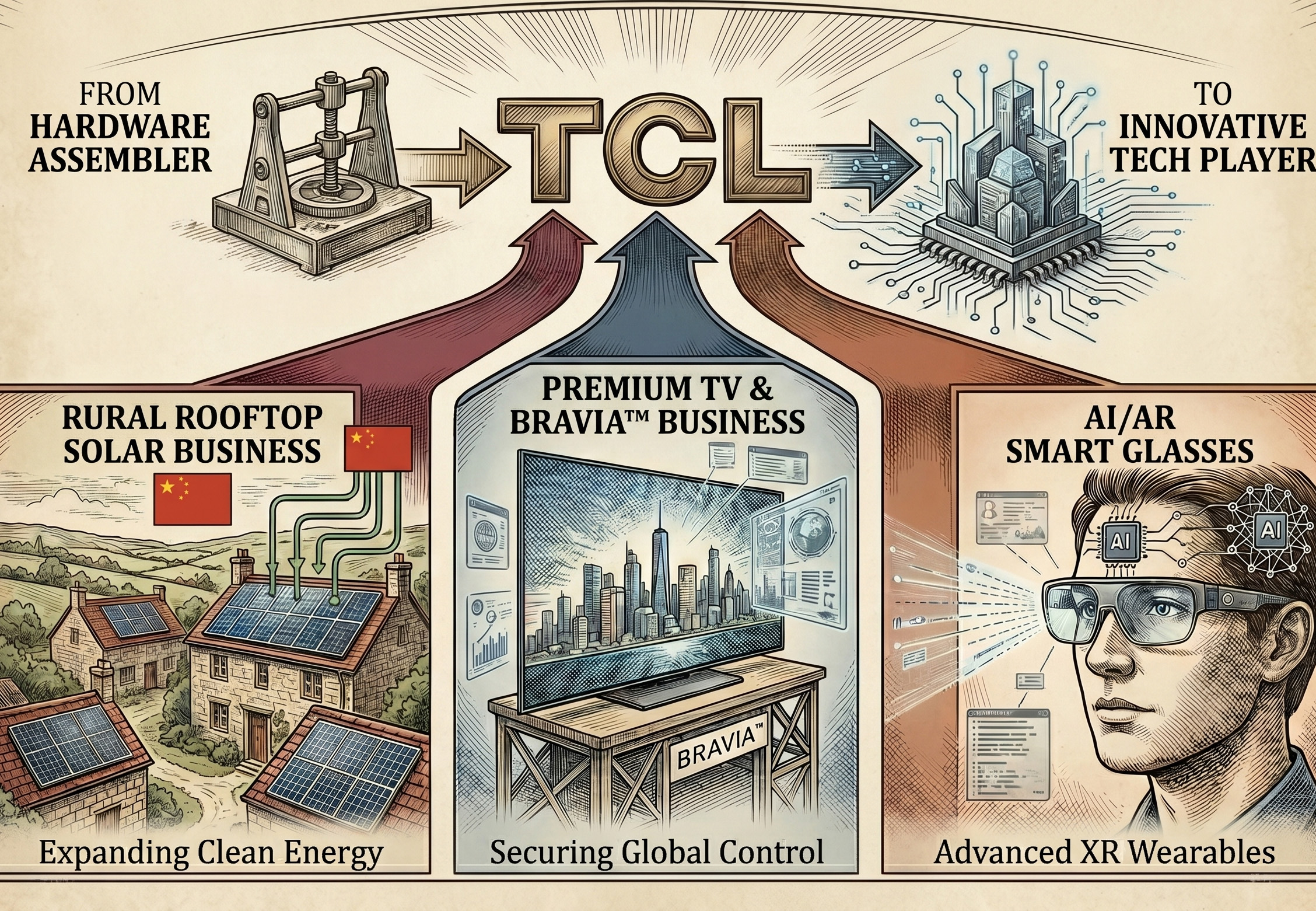
TCL, the world’s No. 2 TV brand, has evolved from a hardware assembler into an innovative platform via a three‑pillar structural pivot: premium TVs, distributed solar and AR smart glasses.
The market has rewarded the shift, driving the stock up more than 5x since 2024.
- The “Rooftop” Powerhouse: TCL has leveraged its deep rural distribution network to build a solar business. By converting idle rooftops into revenue-generating assets, the solar division now contributes 18% of group revenue. Growing at 64% annually, this segment has repositioned TCL as a major player in solar, with newly installed capacity in 2025 enough to power Singapore/Greater London.
- Dominance in Spatial Commerce: TCL’s RayNeo division now commands the No. 1 global market share in AI/AR smart glasses. This is no longer a “lab project”; through its partnership with Ant Group, TCL has pioneered “look-and-pay” functionality, transforming lightweight wearables into frictionless commerce terminals.
- The Premium Consolidation: TCL has effectively broken the Korean-Japanese duopoly in high-end displays. By controlling 31% of the global Mini-LED market and securing majority control of Sony’s global “BRAVIA” business, TCL is capturing the “logo tax” and premium margins that previously eluded Chinese manufacturers.
The Rising Solar Star: A “Hidden Gem” at Scale
TCL is more than TVs. Its solar business is a rapidly scaling “hidden gem.”
In 2025, the solar segment grew revenue 63% and became the company’s second‑largest revenue contributor, accounting for 18% of group revenue.


While TVs and solar panels seem unrelated, TCL has successfully leveraged rural distribution into an energy solution by removing the primary adoption barriers.
- Monetising rural roofs/ Zero‑cost financing: TCL converts unused rural rooftops into microgrids via 15–25 year leases. Homeowners rent out their roofs and get recurring electricity income with zero upfront cost. Partner financial institutions purchase the solar hardware from TCL and collect electricity yields to service the lease. TCL recognises immediate hardware revenue and secures long-term maintenance fees.
- The “free TV” catalyst: TCL bundles long‑term solar leases with complimentary smart TCL TVs or appliances to accelerate sign‑ups.

The Synergy
- The rural network: TCL has spent decades building deep distribution and service networks in rural towns and villages. The same local dealer who sells and installs a TV is now trained to sell and install rooftop solar.
- Brand trust: Rural households are highly risk-averse regarding long-term financial contracts. TCL’s brand equity ensures high contract-signing velocities compared to other solar companies.
- Supply chain leverage: Its sister company, TCL Zhonghuan (002129 CH), is a major manufacturer of silicon wafers. This allows TCL to secure hardware supply without carrying the heavy CapEx on its own balance sheet.
- TVs as energy hubs: TCL repositions smart TVs as the Home Energy Management System (HEMS) dashboard, integrating solar, batteries, EV chargers and appliances into a single localized microgrid ecosystem.
Scale and exportability
Over 360,000 rural household sign‑ups and 340 commercial and industrial projects, ~8GW newly installed capacity in 2025—roughly the output of eight nuclear reactors and enough for millions of households.
That scale repositions TCL as one of the world’s largest distributed‑generation operators.
TCL plans to export the zero‑cost solar playbook using its TV retail and logistics footprint in Europe and other emerging markets.

The Innovation Engine: Wearable Commerce via AI/AR Smart Glass
TCL’s RayNeo currently leads the global consumer AR smart glass market (27% share).
Currently, it commands a dominant share in entertainment-focused smart glasses—devices that function as wearable screens for media and gaming.

Looking forward, it is pivoting into transparent AI glasses.
By pioneering ‘look-and-pay’ functionality with Ant Group on these lightweight, normal-looking glasses, TCL is transforming AR from a simple portable monitor into a frictionless commerce terminal.
How Payment via RayNeo AR Glasses Works:
- Users link their RayNeo AR glasses to their Alipay accounts and enable voice verification.
- In-store, users say, “RayNeo, pay 10 RMB.”
- The glasses scan the Alipay QR code or the Alipay Tap! merchant terminal.
- Users confirm the payment by voice.
The TV Cash Cow: Globalisation and the Premiumisation
TCL is no longer chasing volume alone; it is capturing the premium profit pool.
International markets now generate 73% of display revenue, where TCL has cemented its position as the global No. 2 brand (14.7% market share).


Critically, TCL is improving both scale and margin.
In 2025, display revenue and gross profit rose 9.2% and 16.4% YoY respectively, while segment gross margin expanded 1.1ppt to 16.5%, reflecting the company is premiumising its mix.
Mini‑LED leadership: TCL held the No.1 global shipment ranking for Mini‑LED TVs. Shipments jumped 118.0% YoY in 2025 and now represent 13.0% of total shipments. With a 31.1% share of the Mini‑LED category, TCL is proving it can deliver near‑OLED picture quality at a materially lower price point.
Large‑screen dominance: TCL is also No.1 globally for >75″ and 98″ TV shipments. Models 65″ and up grew 22.7% YoY and now account for 30.5% of volume, securing leading position in a high‑value segment.
Future Driver: The Sony TV JV
Effective April 2027, TCL will assume 51% control of Sony’s global home-entertainment business. By manufacturing and distributing under the Sony and BRAVIA brands, TCL will capture the legacy brand equity and premium pricing power that were previously out of reach.
The Geopolitical Hedge: Bypassing the Tariff Wall
In an era of escalating trade friction, TCL has built a structural hedge via its global assembly facilities targeting key markets.
- Mexico and Vietnam: Primarily serving the US market.
- Poland: A major manufacturing hub in Poland secures “EU Origin” status, dodging the import duty applied to finished Asian electronics.
- Pricing Power: This international footprint allows TCL to maintain aggressive retail pricing in Western stores.
This article is a “periodical publication” for information only and is not investment advice or a solicitation to buy or sell securities. This article does not constitute a “personal recommendation” or “investment advice” under UK FCA regulations. Investing in equities involves significant risk. The author holds NO position in the securities mentioned. There is no warranty as to completeness or correctness. Please do your own due diligence or consult a licensed financial adviser. Please read the Full Disclaimer before acting on any information. Images created with the assistance of Gemini AI.
Latest Post
Leave a Reply