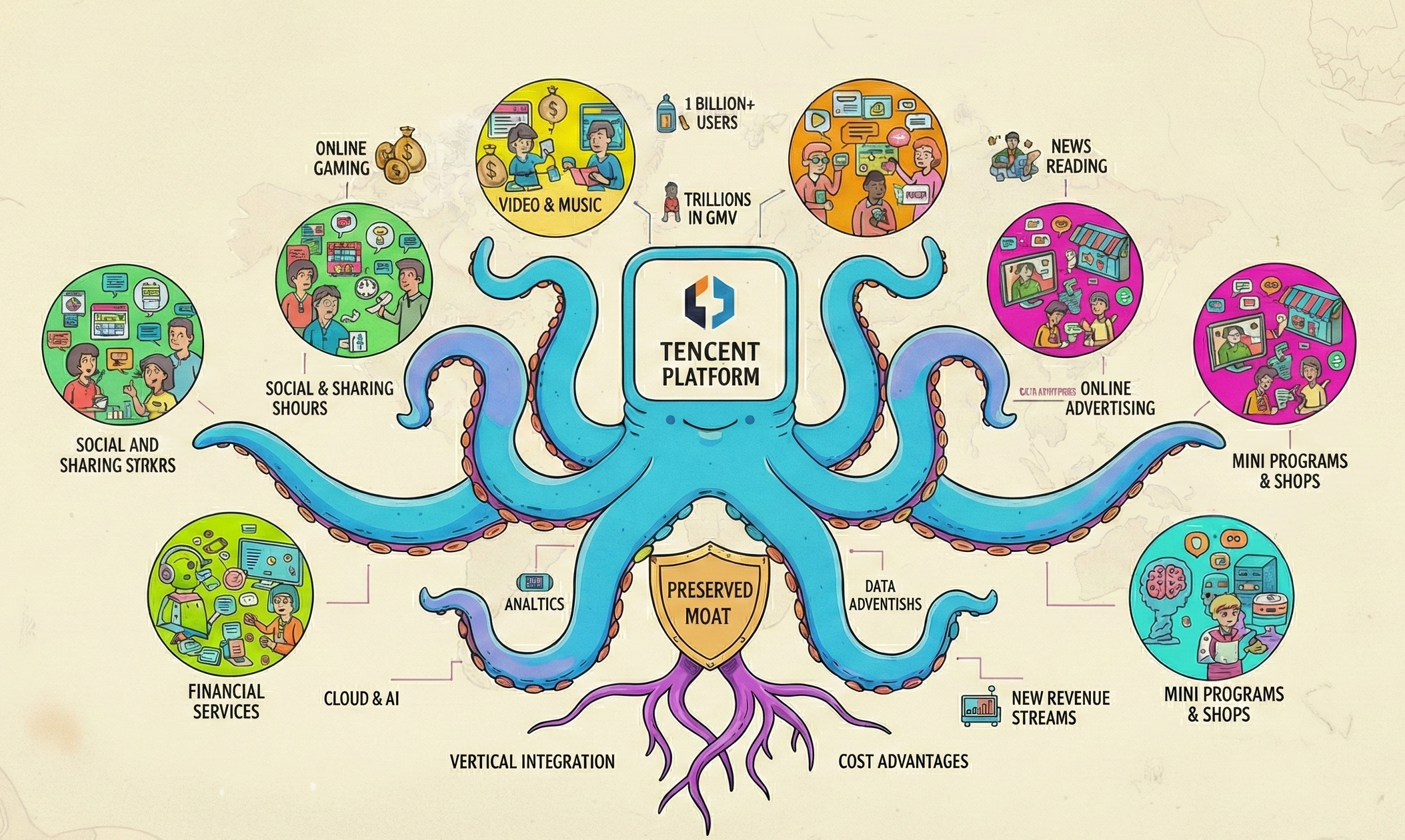
Tencent is one of the rare Chinese internet giants whose economics look robust to cyclical shocks. Its dominant online gaming business is resilient to economic slowdowns, supported by habitual spending, social mechanics, and diverse monetisation. It is also actively monetising its massive WeChat user base, and ongoing AI enhancements across the ecosystem are improving user experience, accelerating content production, and unlocking new revenue streams. Together, these factors preserve Tencent’s moat and support multi‑stream long‑term growth.

Robust 3Q25 performance
Tencent delivered a strong 3Q25, with revenue up 15% YoY and core net profit up 18% YoY. International gaming revenue surged by 43% YoY, led by Supercell titles such as Clash Royale, driving a 23% YoY revenue increase in overall online gaming revenue (domestic + international). Online advertising also showed healthy momentum, rising 21% YoY on the back of improved AI‑driven targeting. Operational improvement lifted core net margin to 36.6% versus 35.8% a year earlier

Source: The company
Unbeatable position in online gaming
Tencent (700 HK) is the clear market leader in China’s online gaming market— roughly 2.5x the revenue of its nearest rival, NetEase.
- Favourable market structure: The market is dominated by a few large players (the top three likely account for >60%), while the remainder is fragmented among smaller developers. Tencent’s scale advantage gives it enduring leverage in R&D, distribution, IP monetisation, etc., helping it maintain its leadership.
- High entry barriers: Strict regulatory approval processes and long development cycles for blockbuster titles discourage meaningful new entrants. Even well-resourced short-video platforms such as Douyin have struggled to establish sustainable gaming franchises, so the segment has not seen the same intense price competition in e-commerce or local services.
- Resilient demand through economic cycles: Gaming’s engagement mechanics and social/network effects create habitual spending on virtual items (cosmetics, season passes) and recurring monetisation (subscriptions, battle passes), while gaming often substitutes for pricier leisure activities—all of which help reduce cyclicality. This resilience is reflected in Tencent’s recent double‑digit online gaming revenue growth in recent quarters.
- International games gaining traction: Tencent’s overseas gaming portfolio—led by Supercell (Clash of Clans, Clash Royale) and Riot Games (League of Legends, VALORANT), is growing quickly. International games delivered 43% YoY growth in 3Q25 and accounted for 33% of online gaming revenue, or about 9% of total revenue.
Monetising a vast social network
Besides online gaming, Tencent is also the largest communications and social network platform in China, offering various features such as instant messages, long and short video, e-commerce, etc., with over 1.4bn MAUs. This allows Tencent to monetise its massive user traffic via online advertising, e-commerce, and premium content, creating diversified revenue streams that complement online gaming.
While advertising is more cyclical than gaming, improvements in AI-driven targeting and creative tools have recently boosted advertising effectiveness and demand, supporting resilient advertising revenue growth.

Source: The company
AI-empowered ecosystem
Tencent is introducing AI across its ecosystem to enhance user experiences, accelerate content production, and unlock new revenue potential.
In WeChat, AI powers intelligent replies, content enrichment, and automated summaries that increase user time and engagement. In games, AI tools speed up content creation, enable more lifelike NPCs and personalise player experiences. In advertising, AI improves targeting, placement, and campaign optimisation, raising click‑through rates and ROI for advertisers.
Overall, these AI initiatives lower operating costs, shorten content production cycles, and lift monetisation efficiency.

Source: The company
This article is for information only and is not investment advice or a solicitation to buy or sell securities. This article does not constitute a “Personal Recommendation” or investment advice under UK FCA regulations. The author holds NO position in the securities mentioned. There is no warranty as to completeness or correctness. Please do your own due diligence or consult a licensed financial adviser. Investing in Asian markets involves significant risk. Please read the Full Disclaimer before acting on any information. Images and videos created with the assistance of Gemini AI.
Latest Posts
- TCL: Transformation Beyond the Screen
- Tencent and Alibaba: The AI Funding Test
- Raising a Lobster: How OpenClaw Reshapes China’s AI Market
- JD.com Disrupts European Delivery: The Last‑Mile Shakeup
- Cheung Kong’s British Blueprint: The Art of the Deal in UK Infrastructure
Disclaimer: This is for information only and is not investment advice or a solicitation to buy or sell securities. There is no warranty as to completeness or correctness and the author accepts no responsibility for errors or omissions. Please do your own due diligence or consult a licensed financial adviser before making any investment decisions. Images and videos created with the assistance of Gemini AI and NotebookLM.
Leave a Reply