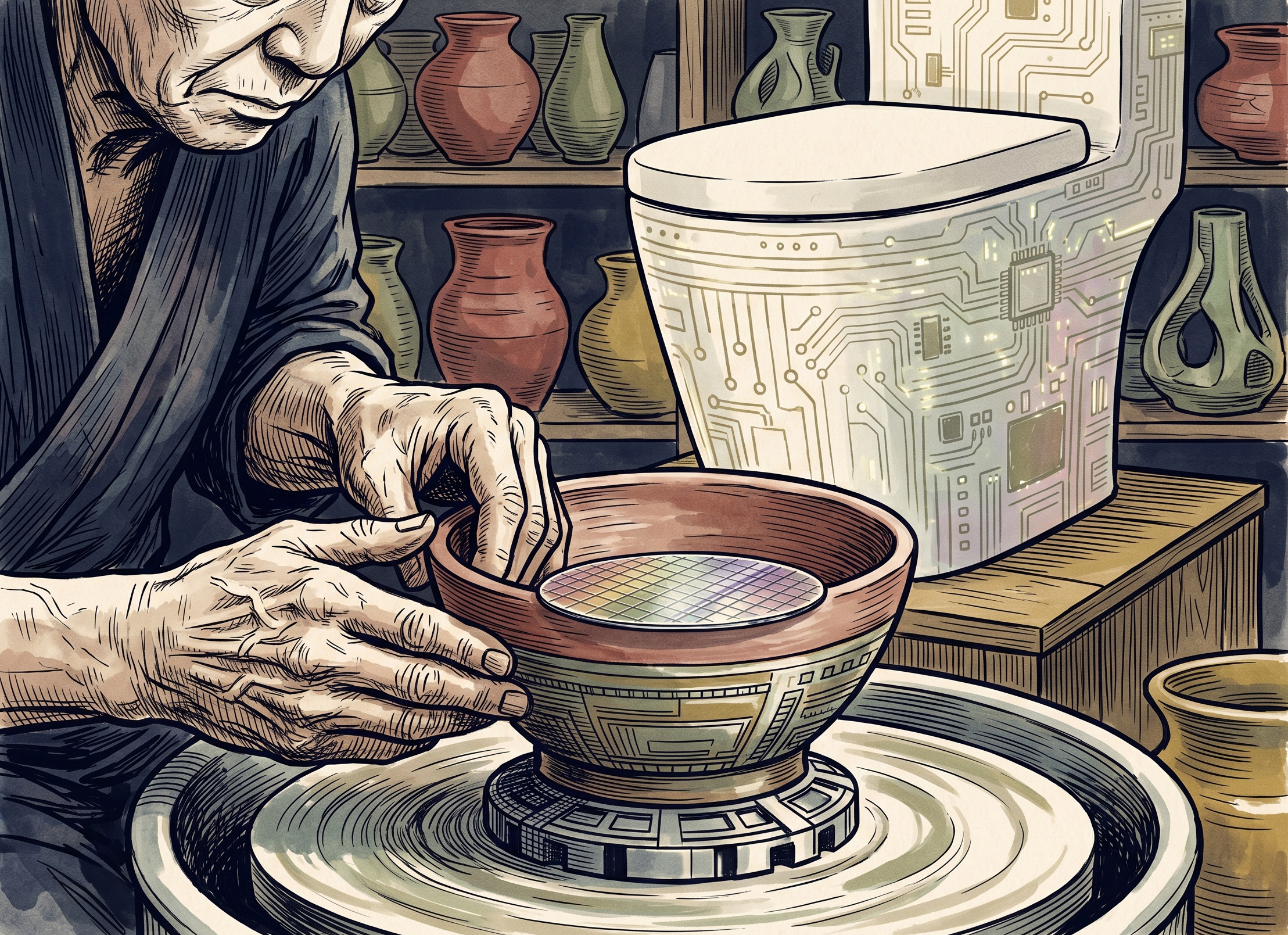
The Hidden Semiconductor Flywheel: TOTO has successfully leveraged decades of ceramic sanitaryware manufacturing expertise on the semiconductor value chain. Its advanced ceramics division now generating 54% of group operating profit, surpassing its legacy housing businesses on 43% operating margin.
Critical AI Infrastructure: TOTO is now the global No. 2 player in the Electrostatic Chuck (ESC) market, a critical component used in the semiconductor manufacturing process. It is a supplier for Lam Research’s cryogenic etching tools, where major memory maker (Samsung, SK Hynix, Micron, Kioxia) used to manufacture advanced 3D NAND flash memory used in AI data centers.
Structural Growth Isolated from Memory Price: The business benefits from a structural growth isolated from memory pricing cycles. As 3D NAND architectures scale toward 1,000 layers by 2030, the demand for cryogenic etching multiplies, driving recurring replacement demand for consumable ESCs.
From Sanitaryware to Semiconductor
TOTO (TYO: 5332) is widely recognized as a premium Japanese bathroom sanitaryware brand. However, fewer notice that the company has transformed itself into a high-margin node in the semiconductor value chain.
In FY2026, TOTO’s advanced ceramics division generated 53.7% of group operating profit.

This is a payoff of a deliberate build. The company launched its ceramics research programme in 1976, hit mass production on electrostatic chucks in 1988, and reached profit inflection in FY2026.
Why ceramics matter for chips
Semiconductor manufacturing requires holding fragile silicon wafers absolutely still under extreme conditions: plasmas, vacuum chambers, nanometre-scale patterning and deposition. Any movement, vibration, or dust ruins the wafer.
Conventional metal clamps or adhesives cannot be used. The solution is ceramic plates with embedded electrodes that use electrostatic force to hold a wafer without physical contact. Only advanced ceramics can survive this environment — they resist plasma corrosion, withstand extreme temperatures, and can be polished to nanometre flatness.
The technical term is Electrostatic Chuck (ESC) — the ceramic component that holds silicon wafers in place during chip manufacturing. It is an important component in the semiconductor production process.

How TOTO becomes an AI infrastructure play
TOTO’s century of ceramic sanitaryware manufacturing maps directly onto the material science demands of semiconductor-grade ceramics.
Compared with sanitaryware, the semiconductor industry demands higher purity and tolerance, but the underlying processes, including precise powder formulation, controlled firing, and ultra-fine polishing, are essentially the same.
TOTO spent decades perfecting them for bathrooms, then applied the same knowledge to chipmaking at higher precision.
Why TOTO’s ceramics are essential to advanced memory chips
TOTO’s electrostatic chucks are engineered for critical processes including cryogenic dielectric etching, which carves microscopic patterns into silicon wafers during 3D NAND memory fabrication.
Building 3D NAND, the flash memory inside AI data centre SSD, smartphone, and laptop, requires stacking over 200 layers of memory cells vertically. To connect these layers, manufacturers need to drill deep, narrow holes through hundreds of stacked layers.
Normal etching uses heat to drive a chemical reaction that carves the hole. However, at this depth, the chemical clogs before reaching the bottom.
The solution is cryogenic etching used by Lam Research. By etching at -70°C to -100°C, the reaction changes without clogging.
TOTO spent decades developing cold-resistant ceramics that maintain uniform temperature under extreme conditions — a capability competitors struggle to match for this specific application.

The Lam Research connection
Lam Research is the major supplier of cryogenic dielectric etching tools to major NAND manufacturers such as Samsung, SK Hynix, Kioxia, Micron. TOTO is a supplier of electrostatic chucks for those tools.
The relationship runs deep. TOTO and Lam have co-developed chamber-level components since 1990. Lam awarded TOTO its Supplier Excellence Award in both 2023 and 2024.
Semiconductor business driving margins
In FY2025, semiconductor ceramics became the largest operating profit contributor (54%), exceeding Japan housing (38%) and overseas housing (14%).
In addition, the ceramic business enjoys a 43% operating margin versus only 4% for housing products.

Structural growth from memory advancement
As 3D NAND layer counts rise, cryogenic etch becomes more important.
Major memory makers are transitioning to 300/400 layer architectures and is expected to achieve 1000 layers by 2030. SK Hynix is mass producing 321-layer NAND. Samsung’s 400-layer line is under development. Kioxia is ramping 332-layer production.
Each additional tier requires more etch steps. Lam Research itself anticipates 3x growth in its cryogenic etch installed base within three to five years.
For TOTO, a major portion of its current ceramics revenue comes from recurring ESC replacement demand — ESCs are consumables that degrade under plasma exposure and require regular replacement.
Looking forward, every new cryogenic etch tool deployed creates a multi-year revenue stream of replacement demand. For example, Micron’s US$24bn investment in a new NAND fab in Singapore, announced in January 2026, adds another layer of demand visibility.
The result is a structural growth independent of short-term memory price cycles. More NAND layers → more cryogenic etch tools → more electrostatic chucks → more replacement demand.
A critical node in the semiconductor value chain
Semiconductor equipment makers have always relied on specialist suppliers for critical components.
Major semiconductor equipment makers, including ASML, Applied Materials, and Lam Research use ESCs in their equipment.
A handful of Japanese ceramic specialists hold the ESC market, including SHINKO, NGK Insulators, NTK CERATEC, TOTO, Kyocera, Sumitomo Osaka Cement.
Japanese companies’ global ESC shipment market share exceeded 97% in 2025, and TOTO ranked No. 2 in the ESC market.
Among them, TOTO is the top global filer of ESC patents from 1995 to 2026, with a heavy concentration in Japanese jurisdictions that gives it a patent moat.
TOTO’s higher operating margin than peers reflects its technical strength.

The activist catalyst
London-based activist fund Palliser Capital identified this opportunity and pressed for greater ceramics disclosure, increased segment investment, and capital efficiency improvements.
TOTO then adopted four key initiatives:
– Improved disclosure of the Advanced Ceramics business, giving investors visibility into its growth and competitive position
– Increased investment in the ceramics segment for sustained growth. It plans ¥30bn in ceramics capex through FY2028 across three factories
– Targeted restructuring of the low-profit toilet business to enhance margins
– Capital structure optimisation toward an appropriate equity ratio
This article is a “periodical publication” for information only and is not investment advice or a solicitation to buy or sell securities. This article does not constitute a “personal recommendation” or “investment advice” under UK FCA regulations. Investing in equities involves significant risk. The author holds NO position in the securities mentioned. There is no warranty as to completeness or correctness. Please do your own due diligence or consult a licensed financial adviser. Please read the Full Disclaimer before acting on any information. Images created with the assistance of AI.
Latest Post
Leave a Reply